
If you’ve ever looked in the mirror and thought, “I look exhausted, even though I slept well,” you’re not alone.
For many people, the issue isn’t tiredness at all. It’s the development of hollowing beneath the eyes, known as the tear trough. This area can cast shadows that make you appear older, more fatigued, or less healthy than you actually feel.
So, is tear trough filler worth it?
For the right patient, in the right hands, the answer can absolutely be yes. But it’s not suitable for everyone, and in some cases, the best advice is not to have treatment at all.
Before You Decide: Understand Why You Look Tired
One of the biggest misconceptions is that dark circles and under-eye hollows are all the same thing.
They aren’t.
The appearance under the eyes can be influenced by:
- Natural facial anatomy
- Ageing and collagen changes
- Redistribution of fat and soft tissue
- Bone structure
- Skin quality
- Genetics
- Lifestyle factors such as sleep, allergies, and dehydration
This is why copying a treatment someone else had rarely produces the best result.
A Real Patient Example
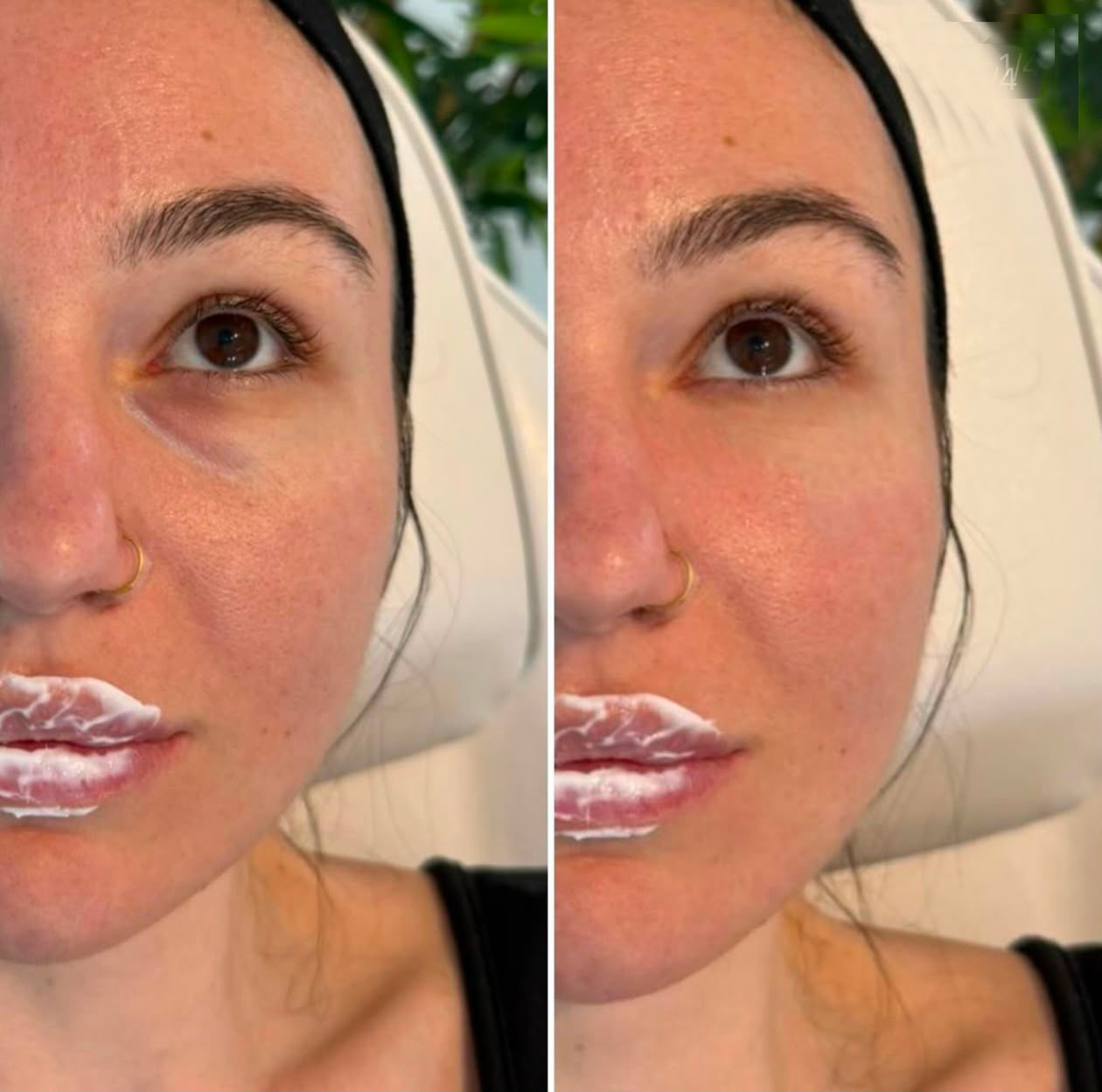
One of our patients, Georgiana, is a naturally beautiful woman in her mid-30s.
She didn’t want to look different.
She didn’t want dramatic changes.
She simply felt her under-eye area made her look permanently tired.
On assessment, the most noticeable issue wasn’t poor skin quality. It was subtle hollowing beneath the eye that created shadowing.
She originally asked about multiple sessions of under-eye skin treatments, believing they would solve the problem.
After discussing her concerns in detail, we recommended a carefully selected tear trough filler treatment instead because it was more appropriate for the issue she was presenting with.
The result was subtle but significant.
Her face still looked like Georgiana’s face.
She simply looked fresher, healthier, and more rested.
The before-and-after photographs accompanying this article were taken immediately after treatment.
My Philosophy: Tweaks Beat Transformations
For the last 12 years, one principle has guided every treatment I perform:
Small, natural improvements almost always age better than dramatic transformations.
If someone already has a beautiful face, they rarely need to look different.
Often they simply need to restore balance.
Sometimes the correct recommendation is tiny adjustments.
Sometimes it’s no treatment at all.
Is Tear Trough Filler Better Than Polynucleotides or Skin Boosters?
This depends entirely on the individual.
If the primary concern is structural hollowing beneath the eyes, carefully selected filler may provide a more immediate improvement.
If the concern is mainly skin quality, fine lines or texture, treatments such as polynucleotides or skin boosters may have a role as part of an overall treatment plan.
The important point is this:
The treatment should fit the diagnosis—not the latest trend on social media.
Who Makes a Good Candidate?
You may be suitable if:
- You have genuine under-eye hollowing
- You consistently look tired despite feeling well
- Your expectations are realistic
- You’re seeking subtle, natural improvement
You may not be suitable if:
- The problem is primarily large under-eye fat bags
- Significant skin laxity is present
- Medical conditions are contributing to swelling or pigmentation
- A surgical approach would produce a better outcome
Sometimes the best consultation ends with advice not to proceed.
Common Mistakes We See
One of my biggest concerns is patients choosing a clinic based purely on price.
These are delicate procedures performed close to important blood vessels and sensitive structures.
Unfortunately, we regularly see patients who have experienced complications elsewhere and require urgent assessment.
Always:
- Research your practitioner thoroughly
- Read genuine reviews
- Be cautious if reviews appear repetitive or artificial
- Ask questions about experience and complication management
The consultation matters just as much as the injection itself.
When I Say “No”
Ethical aesthetics means knowing when not to treat.
If a treatment will not achieve a balanced or natural result, I will advise against it.
The goal is never to make someone look “done.”
The goal is to make them look like the best version of themselves.
Risks of Tear Trough Filler
Every medical procedure carries risk.
Potential complications include:
- Bruising
- Swelling
- Tenderness
- Unevenness
- Infection
- Lumps
- Vascular compromise (rare but serious)
These risks can be reduced with experience, anatomy knowledge, and careful technique — but never fully eliminated.
Recovery
Most patients return to normal activities quickly.
However, mild effects can include:
- Temporary swelling
- Minor bruising
- Tenderness
- Gradual settling over days to weeks
Frequently Asked Questions
Does tear trough filler make you look fake?
Not when performed conservatively. The goal is subtle rejuvenation, not visible change.
How long does it last?
Often many months to over a year, depending on individual factors.
Does it hurt?
Most patients tolerate it well with minimal discomfort.
Is it permanent?
No. It gradually breaks down over time.
Can everyone have tear trough filler?
No. Some patients are better suited to other treatments or surgery.
Final Thoughts
Tear trough filler can be highly effective for the right patient, but it is not a universal solution.
The real goal is not perfection — it is balance.
In many cases, people don’t want to look different. They simply want to stop looking tired.
That is where subtle, well-planned treatment can make a meaningful difference.
At British Cosmetic Clinic in Bristol, we always prioritise natural results, careful assessment, and honest advice — even if that means recommending no treatment at all.
If you would like personalised guidance, a consultation will help determine whether tear trough filler is appropriate for you, or whether another approach would deliver a better outcome.